KATI
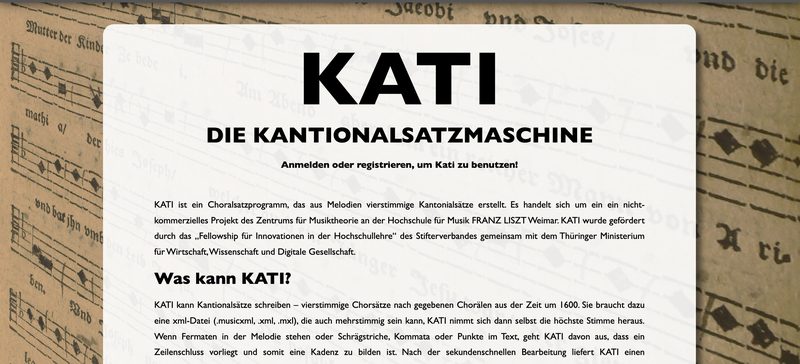
THE KANTIONALSATZ MACHINE
Login or register to use Kati!
KATI is a choral harmonization program that creates four-part 'Kantionalsatz' harmonizations of melodies. It is a non-commercial project from the Music Theory Department of the FRANZ LISZT University of Music in Weimar. KATI was funded by the 'Fellowship for Innovations in University Teaching' of the Stifterverband together with the Thuringian Ministry for Economy, Science and Digital Society.
What does KATI do?
KATI can write 'Kantional' harmonisations - four-part chorals based on chorales written around 1600. KATI should be given a music xml file (.musicxml, .xml, .mxl), which can also be polyphonic (In the case of a polyphonic file, KATI will select the first voice or music system and extract it as the melody to be harmonized). If there are fermatas in the melody or slashes, commas or periods in the text, KATI assumes that the musical line is ending and thus a cadence is to be formed. After quickly processing the file, KATI returns a four-part harmonisation of the melody (as an .xml file) according to the stylistic rules of the time around 1600. It is for this reason that KATI works best when the given a melody that is also from around that time.
Here are some examples of KATI's work:
If you would like to try out KATI or learn more about it, please register, because we want to gain an overview of which groups of people are interested in KATI and for what purpose this Kantionalsatz machine is used.
KATI received funding as part of the 'Fellowships for Innovations in University Teaching' 2021 thanks to the joint initiative of the Baden-Württemberg Stiftung and the Stifterverband. The fellowships are part of the 'Thuringian Strategy for Digitization in Higher Education', which the Thuringian Ministry of Economics, Science and Digital Society developed together with the universities.
Project leader: Prof. Jörn Arnecke, Department of Music Theory
Programmer: Alex James Vaughan
Additional Staff: Philipp Schmidt